Used IBC Totes for Sale
Used IBC totes (Intermediate Bulk Containers) are the most cost-effective way to store and transport bulk liquids. Our pre-owned containers are sourced from reputable manufacturers and distributors, visually inspected for structural integrity, and graded by condition so you know exactly what you are getting.
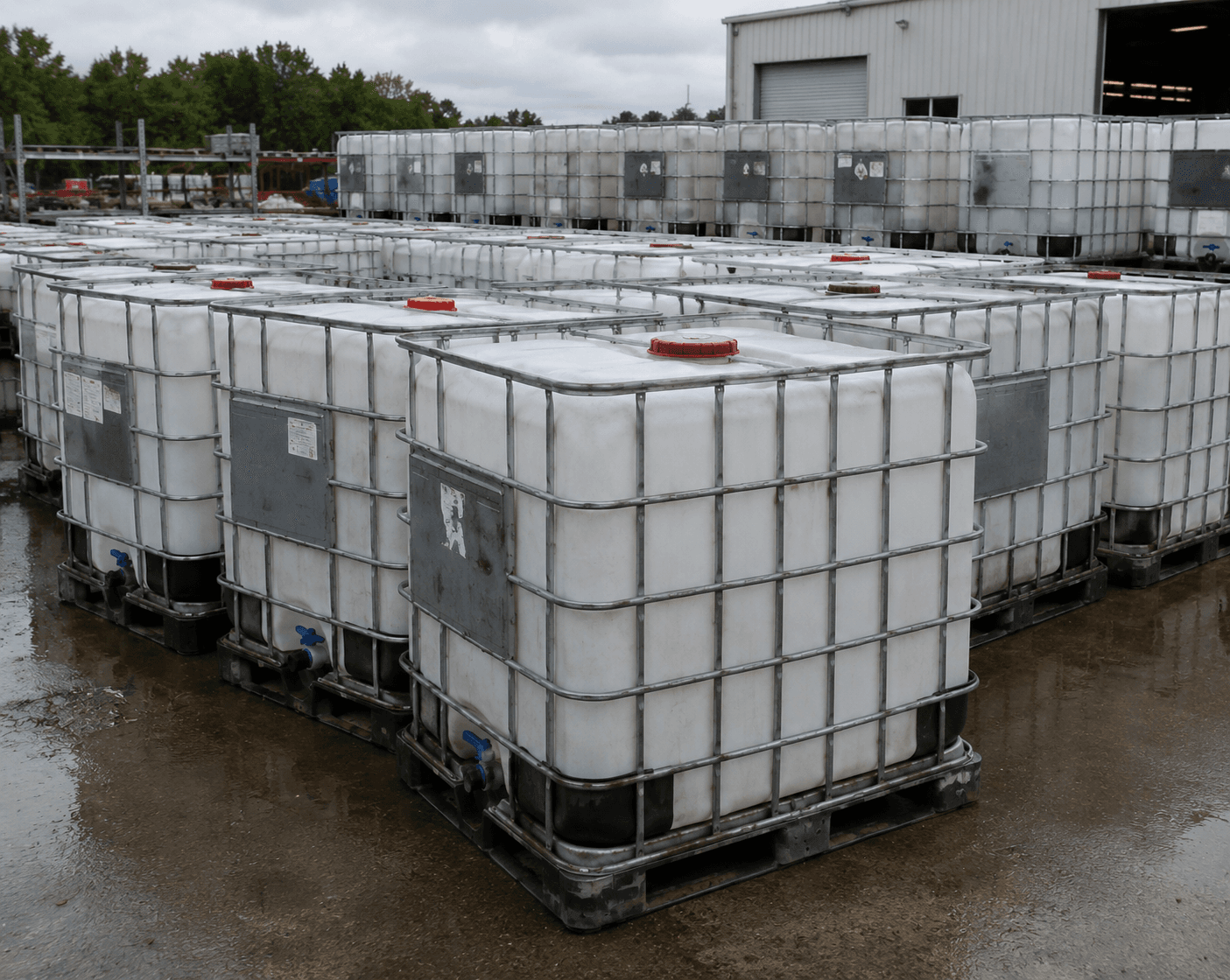
Available in the industry-standard 275-gallon and 330-gallon sizes, each tote features a UV-stabilized HDPE (High-Density Polyethylene) inner bottle encased in a tubular galvanized steel cage, mounted on an integrated pallet for easy forklift handling. Prices start at just $75 per unit, with significant savings on bulk orders.
Available Sizes
We stock the two most common IBC tote sizes used across North American industries.
48" L x 40" W x 46" H
~120 lbs empty
The standard workhorse of the IBC world. The 275-gallon tote fits perfectly on a standard 48x40 pallet and is the most widely available size in the secondary market. Ideal for most storage and transport applications where the full 330-gallon capacity is not required.
Common Uses:
- General liquid storage
- Rain water harvesting
- Agricultural irrigation
- Non-hazardous chemical storage
48" L x 40" W x 53" H
~145 lbs empty
The larger 330-gallon tote provides 20% more capacity on the same pallet footprint. Taller than the 275-gallon model, this size is preferred by operations that need maximum volume per container and have adequate overhead clearance for stacking and storage.
Common Uses:
- High-volume liquid transport
- Industrial wash water
- Bulk chemical storage
- Livestock water supply
Condition Grades Explained
Every used IBC tote we sell is inspected and assigned a condition grade. This transparent grading system ensures you know exactly what you are purchasing.
Grade A
Near-New Condition
From $125
- Minimal cosmetic wear -- light scuffs only
- Bottle is clear or lightly tinted with no staining
- Cage is straight with no bent bars or significant rust
- Original valve and cap in working condition
- Previously held non-hazardous, non-staining liquids
- Suitable for potable water storage with proper sanitization
Grade B
Good Working Condition
From $95
- Moderate cosmetic wear -- scuffs, minor discoloration
- Bottle may have light tinting but no cracks or warping
- Cage may have minor dents or surface rust (structurally sound)
- Valve functional; gasket may show wear
- Previously held industrial liquids (non-hazardous)
- Ideal for irrigation, industrial wash water, bulk storage
Grade C
Budget-Friendly
From $75
- Visible wear -- staining, discoloration, label residue
- Bottle intact but may have cosmetic imperfections
- Cage may have dents or moderate rust (still structurally safe)
- Valve and cap functional but may need replacement soon
- Previously held various industrial products
- Best for non-critical storage, rain catchment, garden use
Our Inspection Process
Every used IBC tote goes through a multi-point inspection before it is graded and listed for sale.
Structural Check
We examine the steel cage for bent bars, broken welds, and structural rust. The pallet base is checked for cracks and forklift damage. Any container with compromised structural integrity is pulled from inventory.
Bottle Integrity
The HDPE bottle is inspected for cracks, warping, UV degradation, and chemical staining. We check the neck fitting, cap threads, and bottom seam. Bottles with any leaks are rejected.
Valve & Fittings
The discharge valve is tested for smooth operation and checked for drip leaks. Gaskets are inspected for deterioration. We verify that all caps, plugs, and adapters are present and functional.
Grading & Documentation
Based on our findings, each tote is assigned a Grade A, B, or C rating. We document prior contents (when known), manufacture date, and any notable conditions. This data accompanies your order.
Common Applications
Used IBC totes are incredibly versatile. Here are the most popular ways our customers put them to work.
Water Storage & Irrigation
Farmers, homesteaders, and landscapers use IBC totes for rainwater harvesting, gravity-fed irrigation systems, and emergency water reserves. A single 275-gallon tote stores enough water to irrigate a large garden for weeks.
Industrial & Manufacturing
Factories and workshops store non-hazardous wash water, coolants, lubricants, and cleaning solutions in used IBC totes. Their forklift-ready design makes them easy to move around the shop floor.
Agriculture & Livestock
Ranchers and farmers use IBC totes as livestock water troughs, fertilizer mixing tanks, and mobile water supply stations for remote fields. The cage protects the bottle from animal damage.
Construction Sites
Contractors use IBC totes for on-site water supply, dust suppression, equipment washing, and temporary fluid storage. Totes are easy to transport on flatbed trucks and position with a forklift.
DIY & Home Projects
Homeowners repurpose used IBC totes into rain barrels, compost tea brewers, aquaponics tanks, and backyard water features. The cage provides a ready-made frame for creative builds.
Emergency Preparedness
Preppers, rural communities, and disaster relief organizations store emergency water supplies in IBC totes. A 330-gallon tote holds enough water for a family of four for over a month.
Frequently Asked Questions
Everything you need to know about buying used IBC totes.
What were the used IBC totes previously used for?
Our used totes come from a variety of industries including food manufacturing, beverage production, chemical processing, agriculture, and general manufacturing. We document the prior contents of each tote when this information is available. Food-grade totes that previously held edible oils, syrups, or juice concentrates are clearly labeled and separated from industrial-use containers.
Can I use a used IBC tote for drinking water storage?
Grade A totes that previously held food-grade liquids can be used for potable water storage after thorough sanitization. We recommend our reconditioned food-grade totes for drinking water applications, as they undergo a certified cleaning process. For non-potable water uses like irrigation, rain catchment, or livestock watering, any Grade A or B tote works well.
How long do used IBC totes last?
The HDPE bottle in an IBC tote has a typical service life of 5-7 years from the date of manufacture, depending on UV exposure, chemical contact, and environmental conditions. The galvanized steel cage lasts significantly longer. When stored out of direct sunlight, a used tote in Grade A or B condition can provide several more years of reliable service.
Do you offer bulk pricing on used IBC totes?
Yes. We offer tiered pricing for orders of 10, 20, 50, and 100+ units. Full-truckload orders (approximately 56 totes) receive the deepest discounts plus reduced freight costs. Contact our sales team for a custom bulk quote tailored to your volume and delivery location.
Can you ship used IBC totes to my location?
We ship to all 50 states from our facility in Fort Wayne, Indiana. Shipping costs depend on quantity, distance, and whether you choose full-truckload or LTL freight. Local pickup is also available at no charge. We can arrange stacked pallet shipping to minimize per-unit freight expenses on larger orders.
What is your return policy on used IBC totes?
Used IBC totes are sold as-is based on their grade description. We provide detailed photos and condition reports for all inventory. If a tote arrives in materially worse condition than described, contact us within 48 hours of delivery and we will arrange a replacement or credit. We stand behind the accuracy of our grading system.
Grading System Visual Comparison
Understanding the differences between Grade A, B, and C used IBC totes helps you select the right container for your needs without overpaying for features you do not require.
| Characteristic | Grade A ($125+) | Grade B ($95+) | Grade C ($75+) |
|---|---|---|---|
| Bottle Clarity | Clear or very lightly tinted, contents visible | Light tinting or haze, contents partially visible | Noticeable discoloration, contents may not be visible |
| Bottle Surface | Smooth with minimal scuffing | Moderate scuffing and minor scratches | Heavy scuffing, label residue, possible staining |
| Cage Condition | Straight bars, no dents, minimal surface rust | Minor dents, some surface rust (structurally sound) | Moderate dents, visible rust patches (still safe) |
| Pallet Condition | Good condition, no cracks or forklift damage | Minor wear, possible small cracks at edges | Visible wear, repaired cracks possible |
| Valve Function | Smooth operation, no drips | Functional, may be stiff or show wear | Functional but may need replacement soon |
| Gasket Condition | Intact with good elasticity | Intact but showing compression set | May be hardened or cracked |
| Prior Contents | Non-hazardous, often food-grade | Non-hazardous industrial products | Various industrial products |
| Odor | None or very faint | Possible faint industrial odor | May have noticeable residual odor |
| Estimated Remaining Life | 3-5 years for liquid storage | 2-4 years for liquid storage | 1-3 years for liquid storage |
| Recommended Use | Water storage, food-adjacent, clean applications | Irrigation, wash water, general industrial | Rain catchment, non-critical storage, DIY projects |
Prior Contents Guide
What was previously stored in a used IBC tote significantly affects its suitability for your intended application. Here is a comprehensive guide to understanding prior contents and their implications.
Food-Grade Prior Contents
Totes that previously held food-grade products are the most versatile and in-demand used containers. Common food-grade prior contents include vegetable oils (soybean, canola, sunflower), fruit juice concentrates, high-fructose corn syrup, vinegar, wine, liquid flavorings, and food-safe cleaning solutions. These totes can be identified by their FDA-compliant labeling and typically have clear or lightly tinted bottles with minimal staining.
Totes that held vegetable oils may have a slight oily residue on the bottle walls, but this is generally harmless and easily cleaned with hot water and dish soap. Totes that held sugar-based products like syrups or juice concentrates are usually very clean after emptying because the sugary residue dissolves readily in water. Vinegar totes are among the cleanest because vinegar is itself a sanitizing agent.
Food-grade totes are suitable for potable water storage (after proper sanitization), livestock watering, garden irrigation, and as starting points for reconditioning to food-grade standards. They command higher prices than industrial-use totes because of their broader application range and cleaner starting condition.
Industrial Prior Contents
Industrial-use totes have held a wide range of non-food products including soaps and detergents, industrial cleaning solutions, glycol-based coolants, water-based paints and coatings, agricultural surfactants, and non-hazardous solvents. These containers typically show more staining and discoloration than food-grade totes because industrial products often contain dyes, pigments, or surfactants that tint the HDPE bottle over time.
The key question with industrial-use totes is chemical compatibility. HDPE is resistant to most common chemicals, but certain aggressive solvents, strong oxidizers, and petroleum-based products can cause the bottle to swell, soften, or become brittle over time. We document the prior contents of every industrial tote when this information is available, allowing you to verify chemical compatibility with your intended use.
Industrial-use totes are ideal for applications like wash water storage, non-potable irrigation, industrial fluid transfer, and construction site water supply. They should not be used for food or drinking water storage without professional reconditioning. If you need a clean starting point for industrial use, consider our reconditioned industrial-grade totes which have been triple-washed and pressure-tested.
Important: Contents We Will Never Sell
We never sell used IBC totes that previously contained hazardous materials classified under EPA or DOT regulations, including pesticide concentrates, corrosive acids or bases, flammable solvents, toxic chemicals, or any substance classified as RCRA hazardous waste. These containers are diverted from our resale inventory and sent to specialized recycling facilities equipped to handle contaminated packaging. Your safety and regulatory compliance are non-negotiable.
If you are unsure whether a used tote is suitable for your intended application, contact our technical team. We can provide prior contents information and help you determine whether a used, reconditioned, or new tote is the right choice for your specific use case.
Step-by-Step Quality Testing
Our quality testing process goes beyond a simple visual check. Here is the detailed protocol every used IBC tote goes through before it earns a grade and enters our inventory for sale.
Document Incoming Condition
When a used tote arrives at our facility, we photograph it from four angles and record the manufacturer, manufacture date (stamped on the bottle), prior contents (from labels or supplier documentation), and visual condition. This incoming record creates a baseline for the grading process and provides traceability data for buyers who need chain-of-custody documentation.
Structural Integrity Assessment
A trained inspector examines the steel cage by running hands along every bar to detect hairline cracks, broken welds, and structural fatigue. The cage is checked for square alignment -- a cage that leans or has been bent out of shape can compromise stacking safety. Pallet runners are inspected for cracks, especially at the forklift entry points where impact damage is most common. Any container with structural safety concerns is pulled from inventory.
Bottle Integrity Examination
The HDPE bottle is inspected for cracks, crazing (network of fine surface cracks from UV exposure), warping, and soft spots that indicate chemical degradation. We pay special attention to the bottom seam, the neck fitting where the bottle meets the cage frame, and the valve port area. The bottle wall thickness is spot-checked at multiple points to ensure it has not thinned below safe operating minimums through chemical exposure or UV degradation.
Valve and Fitting Function Test
The discharge valve is operated through multiple open-close cycles to verify smooth action and positive sealing. We check for drip leaks at the valve body connection, the handle pivot, and the gasket seal surface. The fill cap is inspected for thread damage, cross-threading marks, and gasket compression. All threaded connections are checked for stripped or damaged threads that could compromise seal integrity under pressure.
Residual Contents Assessment
We assess any residual product remaining in the tote. Containers with significant product remaining are drained and the contents identified from label data. The interior is visually inspected through the fill opening for product buildup, mold growth, rust contamination from cage contact, and foreign objects. Any tote with suspicious or unidentifiable residues is rejected from the used-tote inventory and sent for professional cleaning or recycling.
Grade Assignment and Labeling
Based on the cumulative inspection results, each tote receives a Grade A, B, or C designation. The grade, along with our company identification, inspection date, prior contents summary, and manufacture date, is recorded in our inventory system and printed on a label affixed to the cage. This label travels with the tote to the buyer, providing a permanent record of its condition at the time of sale. Our grading decisions are conservative -- when a tote falls between two grades, we assign the lower grade.
Storage & Handling Best Practices
Proper storage and handling practices can significantly extend the useful life of your used IBC totes and maintain the quality of their contents. Follow these expert recommendations to get the most value from your investment.
Storage Recommendations
UV Protection Is Critical
UV radiation from sunlight is the single biggest threat to HDPE bottle longevity. Prolonged UV exposure causes the plastic to become brittle, crack, and eventually fail. Store IBC totes indoors, under a roof, or under UV-protective tarps whenever possible. If outdoor storage is unavoidable, position totes where they receive the least direct sunlight and consider purchasing UV-resistant covers or insulation jackets that block UV rays.
Surface and Foundation
Place IBC totes on flat, level surfaces that can support the full weight of the loaded container (up to 2,500 pounds for a 275-gallon tote filled with water). Concrete pads, gravel pads, and packed earth are all suitable foundations. Avoid soft ground where the pallet can sink and create instability. If storing on grass or dirt, place a sheet of plywood or a concrete paver under the pallet to distribute weight and prevent settling.
Stacking Safely
IBC totes are designed to stack two high when filled, with a maximum stacking load of 4,400 pounds. Never stack more than two filled totes. Empty totes can be stacked three high for storage efficiency. Ensure the cage tops are clean and level before stacking, and verify that the upper cage aligns properly with the lower pallet. On uneven ground, stacking risks increase significantly.
Temperature Considerations
HDPE bottles are rated for temperatures from -40 degrees F to 140 degrees F. In cold climates, drain water-filled totes before hard freezing or ensure sufficient headspace for ice expansion (water expands approximately 9% when frozen). In hot climates, contents may expand and create internal pressure -- use a vented cap to prevent pressure buildup during temperature swings.
Handling and Maintenance
Forklift and Pallet Jack Operation
IBC tote pallets are designed for 4-way forklift entry. When lifting, ensure forks are fully inserted to the opposite pallet runner before raising. Avoid lifting from only one side, which can stress the cage and cause the bottle to shift. Use forks with smooth, non-serrated surfaces to prevent gouging the pallet material. The maximum recommended forklift speed when carrying a filled IBC tote is 3 mph to minimize dynamic loading on the cage and pallet joints.
Valve Maintenance
Operate the discharge valve through a full open-close cycle at least once a month even when the tote is in storage. This prevents the valve from seizing due to product residue or gasket adhesion. If a valve becomes stiff, apply food-grade lubricant to the moving parts. Replace the valve gasket immediately if you notice any dripping at the seal. We stock replacement valves and gaskets for all common IBC tote models.
Cleaning Between Uses
If you are switching the contents of a used IBC tote between different products, flush the tote with clean water at least three times. For switching from a chemical product to water storage, use a hot water rinse followed by a detergent wash and a final clean water rinse. For best results, contact us about our professional IBC cleaning services or consider upgrading to a reconditioned tote with a certified clean bottle.
Inspection Schedule
Conduct a visual inspection of your IBC totes at least quarterly. Check for new cracks in the bottle (especially around the bottom seam and valve port), cage rust progression, pallet damage, valve drips, and cap gasket deterioration. Catching problems early prevents product loss and safety hazards. A tote that is developing cracks or showing significant UV degradation should be retired from liquid storage and considered for repurposing.
Real-World Application Examples
Here is how customers across different industries are using used IBC totes to solve real operational challenges while saving thousands of dollars compared to alternative solutions.
Organic Farm -- Gravity-Fed Irrigation System
Grade A used totesChallenge
A 15-acre organic vegetable farm in Ohio needed a cost-effective way to distribute water and liquid organic fertilizer to raised beds across the property. Traditional plumbing would have cost over $8,000 and required extensive trenching.
Solution
The farm purchased 12 Grade A used IBC totes (previously held food-grade vegetable oil) at $125 each. They positioned the totes at elevated points around the property, connected them to the drip irrigation system using garden hose adapters and Y-splitters, and created a gravity-fed distribution network. Two totes were dedicated to mixing and dispensing liquid fish emulsion fertilizer.
Result
Total cost: approximately $1,800 for totes plus $300 in accessories -- saving over $5,900 compared to permanent plumbing. The system is flexible, portable, and the totes can be repositioned between seasons as crop layouts change.
Construction Company -- Multi-Site Water Supply
Grade B used totesChallenge
A general contractor operating across five active job sites in Indiana needed portable water supply for dust suppression, concrete curing, and equipment wash-down. Renting water trailers was costing $1,200 per month across all sites.
Solution
The company purchased 15 Grade B used IBC totes at $95 each. Three totes were assigned to each job site, transported on flatbed trucks, and positioned using the site forklift. Each tote was fitted with a garden hose adapter for easy connection to a pressure washer or water cannon.
Result
One-time cost of $1,425 plus $105 in adapters replaced a $1,200 monthly rental expense. The totes paid for themselves in less than six weeks and have been in continuous use for over two years with only minor valve replacements needed.
Rural Community -- Emergency Water Reserve
Grade A used totesChallenge
A small rural community in Kentucky without redundant municipal water supply needed an emergency water reserve for potential infrastructure disruptions. Commercial water storage tanks were quoted at $3,000-$5,000 for comparable capacity.
Solution
The community purchased 8 Grade A used IBC totes (previously held food-grade corn syrup) at $125 each. After cleaning with a bleach solution and rinsing, the totes were filled with treated water and stored in a community building basement. The totes are rotated (emptied and refilled) every six months to maintain water freshness.
Result
Total cost of $1,000 provides 2,200 gallons of emergency water reserve -- enough for 55 households for two days of basic water needs. The system cost 70-80% less than purpose-built emergency water tanks and provides the same capacity with easier installation and maintenance.
Cost Savings Breakdown
Used IBC totes deliver dramatic cost savings compared to other liquid storage options. Here is a detailed comparison across common alternative solutions.
| Storage Solution | Capacity | Cost | Cost per Gallon | Portability |
|---|---|---|---|---|
| Used IBC Tote (Grade B) | 275 gal | $95 | $0.35 | Forklift-ready, stackable |
| Used IBC Tote (Grade A) | 275 gal | $125 | $0.45 | Forklift-ready, stackable |
| New IBC Tote | 275 gal | $280 | $1.02 | Forklift-ready, stackable |
| 55-Gallon Drum (used) | 55 gal | $25 | $0.45 | Hand-truck, limited stacking |
| 55-Gallon Drum (new) | 55 gal | $80 | $1.45 | Hand-truck, limited stacking |
| Polyethylene Tank (300 gal) | 300 gal | $350+ | $1.17 | Not easily moved |
| Stainless Steel Tank (300 gal) | 300 gal | $2,000+ | $6.67 | Not easily moved |
| Water Trailer Rental (300 gal) | 300 gal | $200/mo | $0.67/mo | Towable |
The Bottom Line on Cost Savings
A Grade B used IBC tote at $95 provides 275 gallons of portable liquid storage at just $0.35 per gallon of capacity. To get the same 275 gallons using 55-gallon drums, you would need five drums at $25 each ($125 total), taking up more floor space and requiring more handling labor. A comparable new polyethylene tank costs $350+ and is not easily moved with a forklift. When you factor in the forklift portability, stacking capability, and built-in valve that IBC totes provide, the value proposition becomes even stronger.
For operations that need bulk liquid storage on a tight budget, used IBC totes are the undisputed champion of cost-per-gallon value. Contact us for volume pricing on orders of 10 or more units for even greater savings.
Common Misconceptions Debunked
There are many myths and misunderstandings about used IBC totes. Here are the most common ones, along with the facts that set the record straight.
Myth: Used IBC totes are unsafe for water storage.
Fact: Grade A used totes that previously held food-grade products are perfectly safe for water storage after basic sanitization (a dilute bleach solution rinse followed by a clean water flush). The HDPE plastic used in IBC bottles is the same material used in milk jugs and food-grade water containers. It does not leach harmful chemicals and is approved by the FDA for food contact. The key is knowing the prior contents and cleaning the tote appropriately before use. For drinking water applications, we recommend our reconditioned food-grade totes for maximum assurance.
Myth: Used totes always smell bad and cannot be cleaned.
Fact: The vast majority of used IBC totes have no significant odor. Totes that previously held food-grade products like vegetable oil, syrup, or vinegar typically have no detectable smell after a basic rinse. Totes that held industrial products may have a faint chemical odor, but this usually dissipates with one or two rinses with hot water and baking soda. Totes with persistent strong odors are downgraded in our system and clearly labeled. We never misrepresent the odor condition of our inventory.
Myth: The plastic in used totes degrades and becomes dangerous.
Fact: HDPE is one of the most chemically stable plastics available. It does not break down into harmful byproducts under normal storage conditions. UV radiation from sunlight is the primary degradation factor, and it causes the plastic to become brittle rather than releasing toxins. A used tote stored indoors or under shade can remain structurally sound for 5-7 years from the manufacture date. Microplastic concerns that apply to thin-film plastics (like bags and wraps) are not relevant to the thick-walled HDPE bottles used in IBC totes.
Myth: You need a brand-new tote for any non-trivial application.
Fact: New totes are necessary only for a narrow range of applications -- primarily pharmaceutical manufacturing, certain food production processes requiring zero contamination risk, and situations where customer contracts specifically mandate virgin packaging. For the vast majority of commercial, industrial, agricultural, and residential applications, a properly graded used tote or a reconditioned tote performs identically to a new one at 30-60% of the cost. Millions of used IBC totes are in productive service across the United States at any given time.
Myth: All used IBC totes are the same -- grading is just marketing.
Fact: Our grading system reflects real, measurable differences in container condition that affect performance and longevity. A Grade A tote with a clear bottle, straight cage, and functional valve is a fundamentally different product from a Grade C tote with staining, cage dents, and a worn valve. The grade determines what applications the tote is suitable for, how long it will last in service, and whether any accessories (like replacement valves) should be purchased alongside it. We encourage buyers to request photos of specific totes before ordering if they want to verify the condition aligns with the grade description.
Myth: Buying used is not worth the hassle when new totes are available.
Fact: At $75-$125 per unit versus $280+ for a new tote, the cost savings of buying used are substantial. For an operation deploying 20 totes, the savings range from $3,100 to $4,100 -- money that can be invested in your actual business operations. The "hassle" of buying used is minimal when you work with a reputable supplier that grades accurately, documents prior contents, and ships promptly. Our repeat customer rate exceeds 70%, which tells us that buyers who try used totes overwhelmingly find them to be a worthwhile value.
Ready to Order Used IBC Totes?
Get a free quote in minutes. Whether you need 1 tote or 100, we have the inventory and the pricing to meet your needs.